
Running a Sex Offender Check in Stanly County
Two official channels serve a Stanly County registry search. The North Carolina Sex Offender and Public Protection Registry is maintained through the State Bureau of Investigation. Stanly County sheriff personnel collect and verify the county registration information entered in that system. The Stanly County Sheriff's Office registry interface supplies a county-focused map and list. Start with the state registry when the search may extend beyond Stanly County. Use the sheriff view when the local map is the most useful frame.
Before searching, gather a full name and any known alias, then note a city, street, or other place tied to the inquiry. Similar names can produce the wrong match. Open the full profile and compare several fields rather than relying on a photograph or one address. A registry entry concerns a statutory registration duty. It is not a broad account of every court filing, and it should not be stretched beyond the facts shown.
The official state registry search screen shows how North Carolina presents the public search layer.
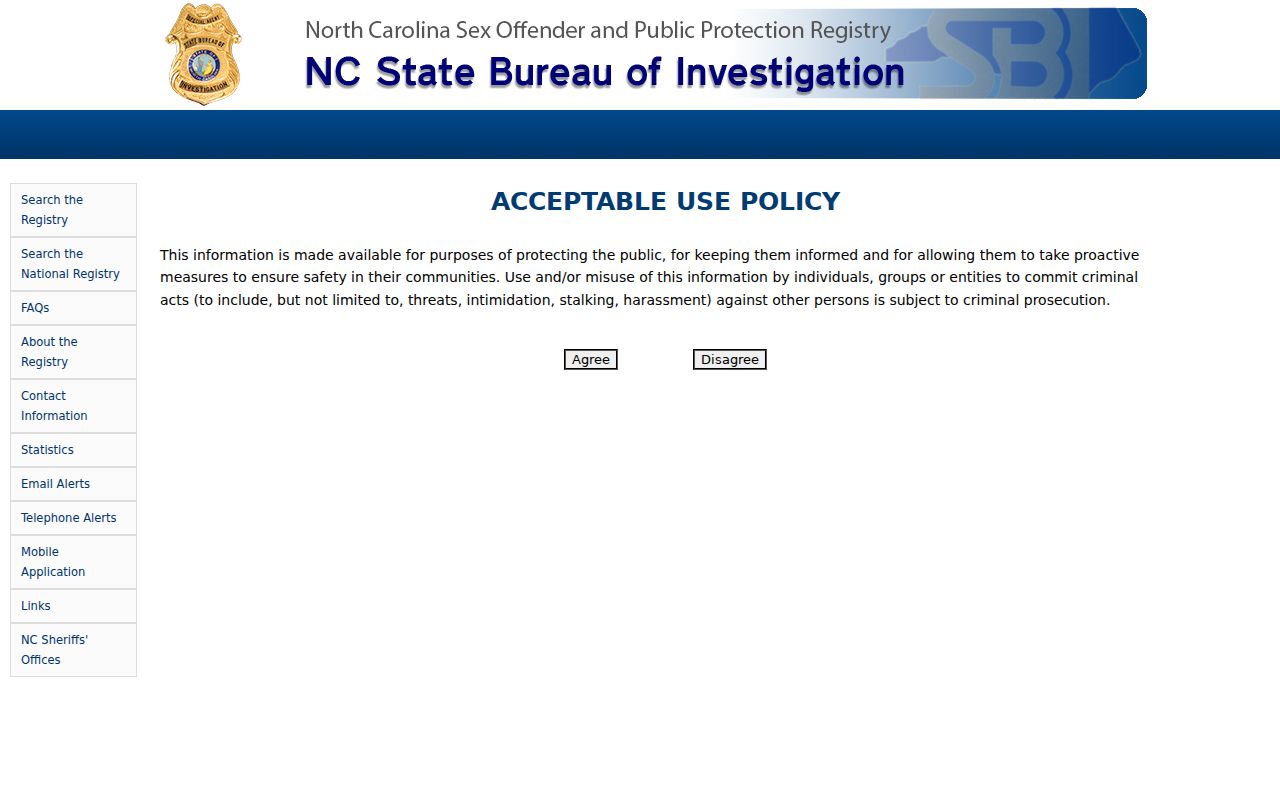
That statewide entry point complements the narrower Stanly County sheriff map rather than replacing it.
Stanly Registry Acceptable-Use Gate
North Carolina places an acceptable-use page before its public registry. The gate states the public-protection purpose and requires users to acknowledge limits before moving to the search. It also routes users to FAQs, contact information, statistics, email alerts, telephone alerts, the national registry search, and a mobile option. Those paths matter because a profile lookup and a move alert answer different questions.
Read the SBI registry disclaimer before continuing. It warns that using registry information to commit a crime, including threats, intimidation, stalking, or harassment, may lead to prosecution. The warning protects registrants, household members, and the public. Report a concern to law enforcement; do not visit an address to question or confront anyone.
Searching the North Carolina Sex Offender and Public Protection Registry
The SBI registry supports identifying and geographic criteria, including name and address-based proximity. Its controls can change, so use the labels on the live screen and avoid assuming that an old screenshot describes every current option. A sound Stanly County sex offender search follows a short sequence:
- Open the official SBI registry and read the acceptable-use terms before entering the search.
- Choose an identifying search or a geographic search based on what is already known.
- Review possible results and compare more than one identity or location field.
- Open the profile, inspect status and offense details, then confirm concerns through the sheriff.
| Field Label | Type | Required | Notes |
|---|---|---|---|
| Name or offender identity | Identifying criteria | Depends on search | Use the most complete known name and inspect aliases on a profile. |
| Address or proximity | Geographic criteria | Depends on search | Supports place-based safety checks around a known address. |
| County or local place | Geographic filter | No universal requirement stated | Narrow the results to Stanly County when the inquiry is local. |
| Map and result view | Display control | No | Compare mapped location context with the underlying profile. |
The SBI Criminal Information and Identification program explains the agency setting behind this public system.
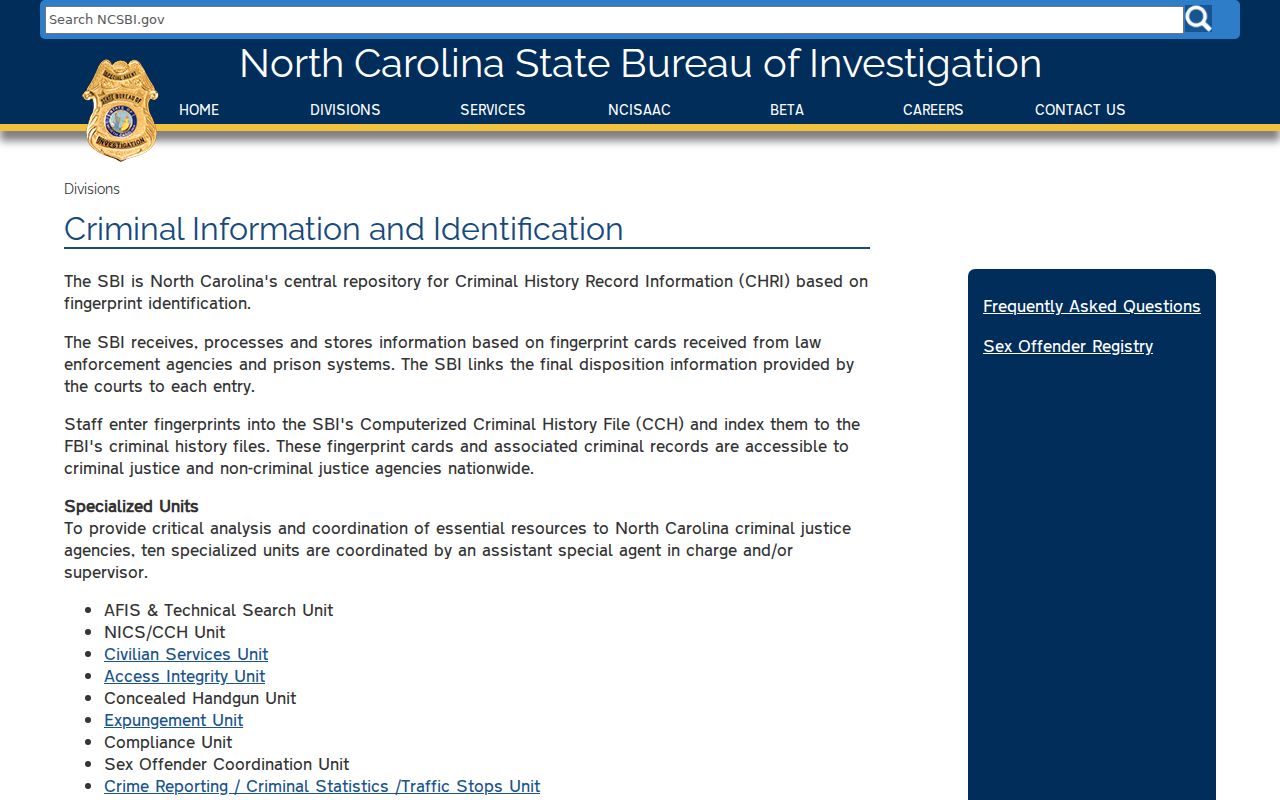
County-entered registry data sits within that broader state criminal-information function, but the registry remains its own public tool.
Stanly County Registry Map
The sheriff interface offers the closest local lens. Its value is geographic focus, while the SBI registry supplies the statewide framework and supporting material. A person who lives near a county line should check the state tool as well. County borders do not limit where a person may move, work, attend school, or have a reportable connection, and a narrow map view can miss relevant nearby entries.
The official Stanly County registry map and list demonstrates that local view.
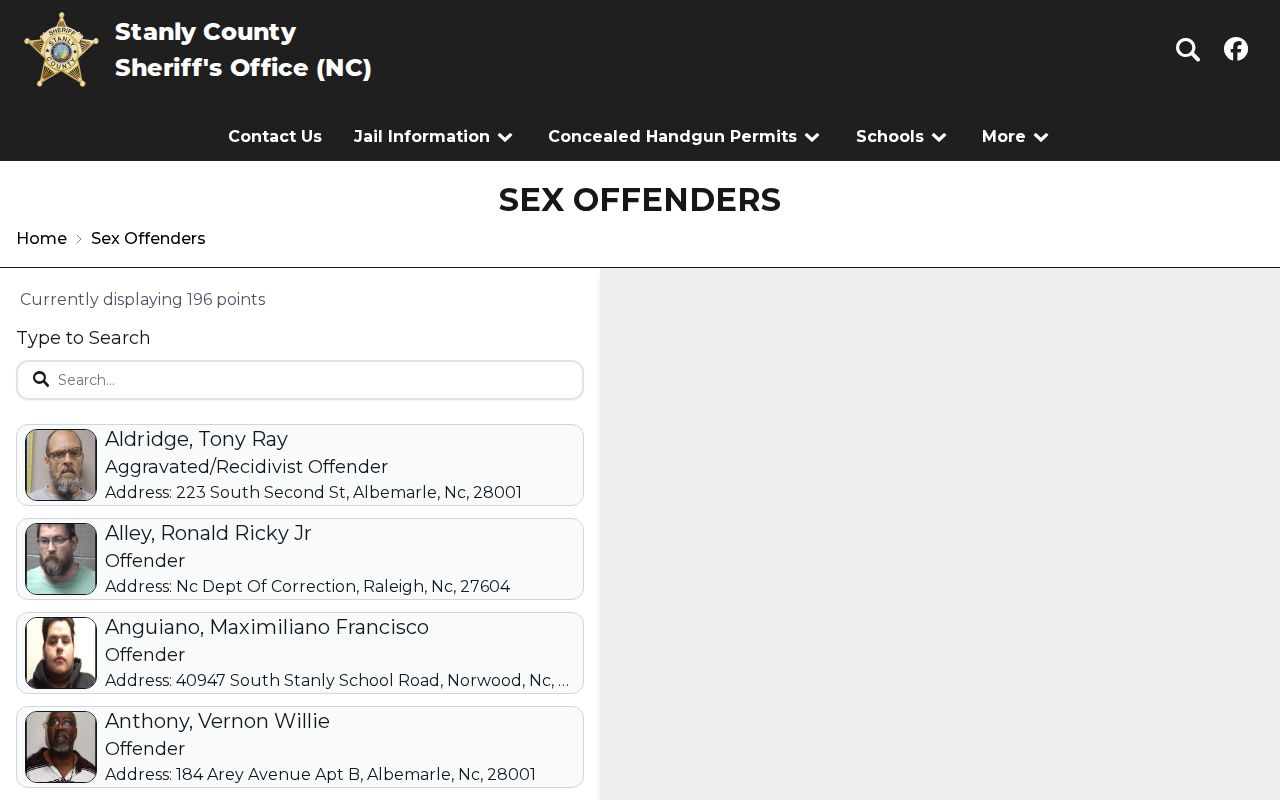
Use the map as a starting point, then open and read the state profile before drawing a conclusion.
For a search beyond North Carolina, use the official National Sex Offender Public Website. NSOPW links public registry information across participating jurisdictions. It is the sound fallback when a person or address has ties to another state. It does not replace local law enforcement when a Stanly County entry appears wrong or when noncompliance is suspected.
What a Registry Profile Shows
A Stanly County registry profile groups identity, description, registration, location, conviction, and permitted association data. Not every profile contains every field. Read the record as a set of reported facts, and do not infer an unlisted fact from a blank field. Public categories supported by official registry material include:
| Name and aliases | The primary registered name and any public aliases. |
|---|---|
| Photo and description | Photograph plus public sex, race, age or birth information, height, weight, hair, and eye details. |
| Distinguishing features | Scars, marks, and tattoos when those details are present. |
| Registration status | Category, status, verification or compliance information, and county. |
| Registered location | Residential address at the level made public by the registry. |
| Conviction details | Jurisdiction, offense description or statute, conviction date, and other public offense facts. |
| Public associations | Vehicle, school, or work information where law and the record permit display. |
A photograph can age, and an address reflects reported registry data rather than a promise that the person is present at that moment. Status and verification fields deserve as much attention as identity data. If details conflict, note the profile and contact the Stanly County Sheriff's Office instead of trying to resolve the issue in person.
Stanly Registry Data Corrections
Stanly County sheriff personnel collect and verify local registration information, then enter it into the statewide registry. That chain determines where to raise an apparent error. Record the profile page, the field that seems wrong, and the official information that conflicts with it. Send the concern to the Sheriff's Office. The SBI maintains the statewide system, but county sheriffs supply the underlying registration entries.
A suspected violation calls for the same restrained response. Share the facts with law enforcement and let the agency check them. Do not publish an accusation, follow a person, enter private land, or attempt to prove residence through confrontation.
Stanly Registry Move Alerts
The SBI FAQ describes email notification tied to saved North Carolina addresses. A user may select a one-, three-, or five-mile distance and may register more than one address. This tool is useful for community awareness because it tracks a reported move near a chosen place without requiring repeated manual searches.
The official registry notification and search FAQ sets out the alert choices.
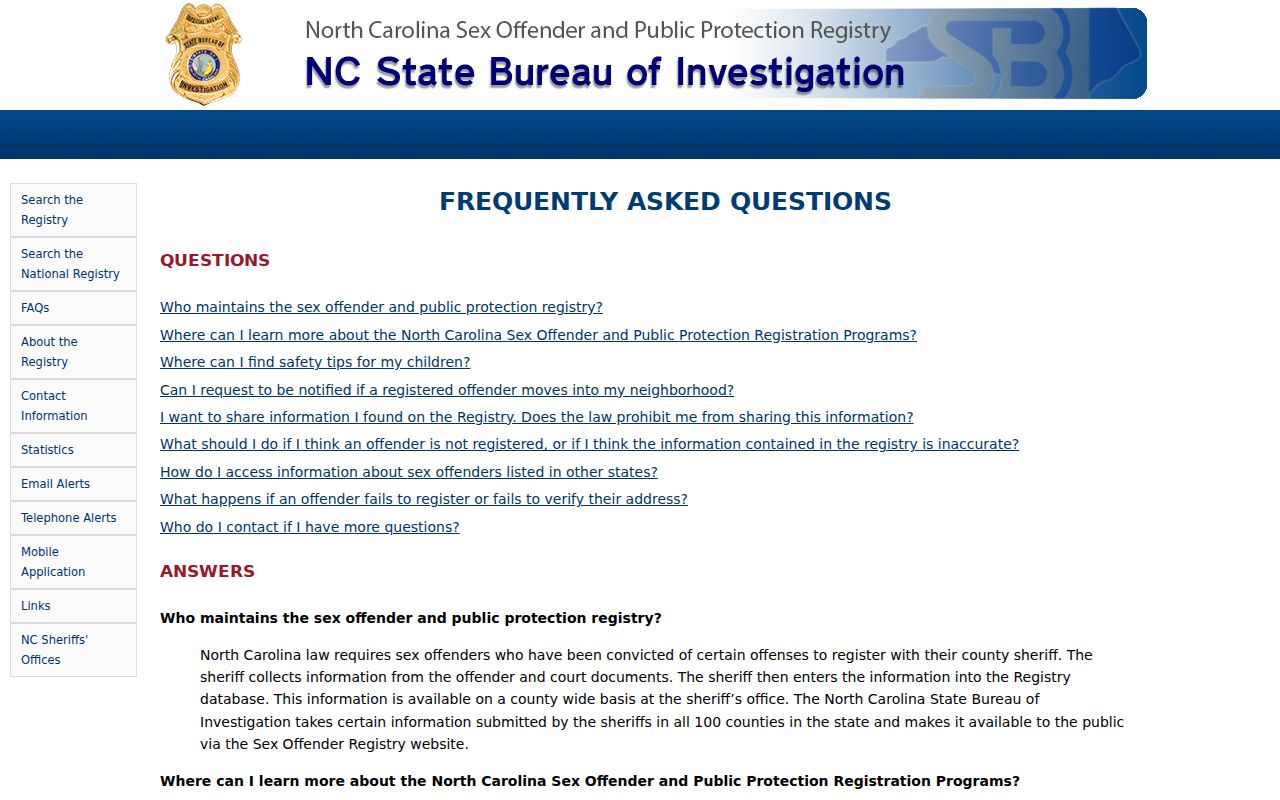
Choose a radius that fits the safety question and keep the saved address current so the alert remains useful.
Do not confuse registry move alerts with the custody-status action on the Stanly County jail roster. The roster notification concerns a person's county custody status. A registry alert concerns a reported address near a saved location. Each comes from a different system and tracks a different event.
Registration Requirements and Levels in North Carolina
North Carolina does not publish a simple Tier I, Tier II, and Tier III scheme for this purpose. The statutes distinguish ordinary Part 2 registration from lifetime categories. Under G.S. 14-208.6, key definitions include reportable conviction, aggravated offense, recidivist, and sexually violent predator. The duration table must be read through those North Carolina terms:
| North Carolina category | Duration or consequence | Public visibility |
|---|---|---|
| Part 2 registrant | At least 30 years from initial county registration; a petition may be possible after 10 years if statutory criteria are met. | Public information appears as authorized by the registry law. |
| Recidivist | Lifetime registration under applicable Part 3 provisions. | Public registry information remains subject to statutory rules. |
| Aggravated offender | Lifetime registration under applicable Part 3 provisions. | Public registry information remains subject to statutory rules. |
| Sexually violent predator | Lifetime registration with applicable verification duties. | Public registry information remains subject to statutory rules. |
G.S. 14-208.7 directs a resident to register with the sheriff in the county of residence. The law generally requires registration within three business days after release or arrival to live in a county, with separate wording for conviction without an active prison term and for arrival from another state. A 30-year period does not mean automatic removal on the thirtieth anniversary. The petition route and statutory findings still matter.
Stanly Registry Statistics Limits
The SBI statistics display is based on information entered by the state's sheriffs. A count is therefore a database measure, not an independent census of every person who may have a duty to register. A pending entry, correction, move, or compliance review can affect what appears. Search the live registry when the question concerns a particular address or person instead of treating a summary count as the answer.
The same caution applies to county comparisons. Population, local movement, entry timing, and reporting status can shape a total. Statistics offer context, while the current profile and confirmation from the Stanly County Sheriff's Office provide the case-specific route.
Stanly Registry Residence Rules
Residence limits and presence limits are not the same rule. G.S. 14-208.16 bars a covered registrant from knowingly residing within 1,000 feet of the property line of a public or nonpublic school or child-care center. The rule applies when the residence was not established before August 16, 2006. Home schools and colleges are excluded from the statute's school definition.
By contrast, G.S. 14-208.18 addresses knowing presence for specified offense categories at certain places used by minors. It includes detailed conditions and exceptions for such matters as emergency care, voting, eligible students, treatment, and supervised school visits by a parent or guardian. A violation is a Class H felony. The facts and the exact statutory category control, so a map pin alone cannot answer whether a place is lawful.
Questions about a Stanly County address belong with the sheriff and, when legal interpretation is needed, qualified counsel. Neighbors should not measure, enter property, follow a person, or attempt their own compliance check.
Lawful Use and Community Notification
Registry records exist for public protection, informed community awareness, and practical safety planning. They can help a family understand reported locations near a home, school route, or other place. They also help users identify which sheriff holds the county registration. The records do not grant authority to confront, punish, follow, expose, or police a registrant or anyone in the household.
Misuse can be prosecuted: The SBI acceptable-use policy warns that using registry information for threats, intimidation, stalking, harassment, or other criminal acts may lead to criminal prosecution.
Suspected noncompliance should go to law enforcement, not a neighborhood group or an individual investigator. Give the sheriff the profile details and the reason for concern. If an entry seems incorrect, report the mismatch to the Stanly County Sheriff's Office because county sheriffs enter and verify the information that feeds the state database. The official registry statistics page confirms that its figures come from data entered by North Carolina sheriffs.
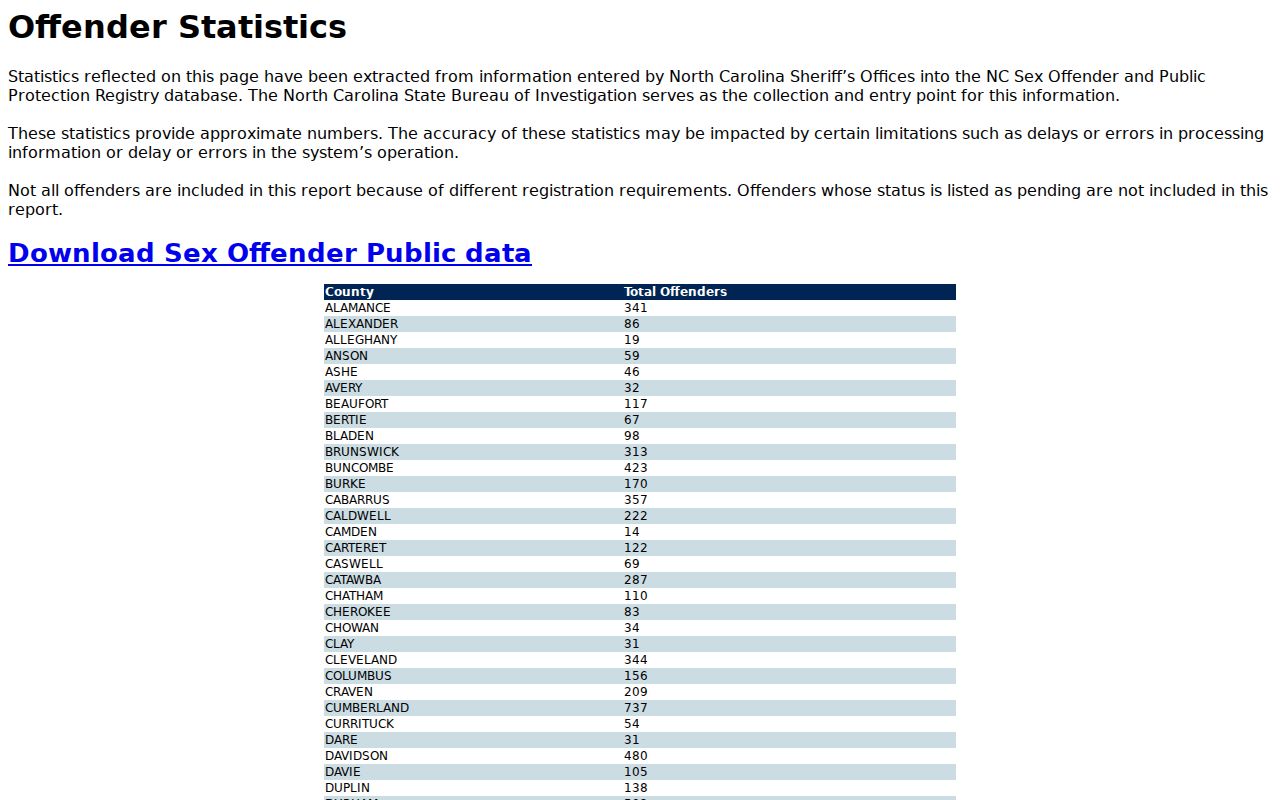
Statistics describe the database at a point in time and should not be used as a substitute for a current profile search.