
How to Check Criminal History in Locust
Begin with the Locust Police Department when the city made the report. Its staff can address incident and arrest records that do not appear in the public statistics archive. Next, determine whether the event took place in Stanly County or Cabarrus County. That fact controls which county jail and clerk may hold later records. North Carolina eCourts Portal can search public cases online, while courthouse terminals and clerks provide stronger document and certified-search options.
- Identify the event location, date, responding agency, and any report number.
- Check Locust's official monthly archive for a posted statistical report or arrest PDF.
- Call the Locust police office for the report-copy method because no dedicated request form or fee schedule is published.
- For a Stanly-side arrest, check the Ralph McSwain roster and Stanly court channels; verify Cabarrus channels for a Cabarrus-side event.
- Use SBI Right to Review only for a fingerprint-based copy of your own North Carolina history.
Match a name with a case number, agency, date, charge, and disposition. A posted arrest item is not a conviction. The court judgment supplies the outcome, while the police report explains what Locust officers recorded at the start.
Two-County Locust Arrest Records
The official 2024 estimate places 5,992 people in Locust, with 5,295 in Stanly County and 697 in Cabarrus County. A Locust city label alone cannot identify the proper county custodian. A Locust police report remains with the Locust department, but the place of arrest and booking agency may route the Locust custody record and court file to different counties.
| Question | Stanly-side route | Why it matters |
|---|---|---|
| Who made the report? | Locust Police Department | The agency report starts with its creator |
| Where is current custody? | Ralph McSwain roster when booked in Stanly | A city has no advertised detention center |
| Where is the court case? | Stanly clerk when filed in Stanly | City boundaries do not set county venue by themselves |
Ask which county appears on the Locust citation, warrant, booking, or case number. If that detail is unclear, call Locust PD first. Locust staff can confirm the incident location and provide the local report route without requiring a guess about county ownership.
The Locust Police Department
The Locust Police Department contact page lists 186 Ray Kennedy Drive, 704-888-4744, and fax 704-888-1566. Office hours are Monday through Friday, 8:30 a.m. to 5 p.m. Chief Jeff Shew can be reached at jbshew@locustnc.gov. The city has not published a separate report-copy form, online case portal, or fee schedule, so call the department and describe the requested record.
The official Locust police contact source shown below gives the correct city starting point. It is a Locust contact route, not a promise that every Locust police record can be emailed or released in full.
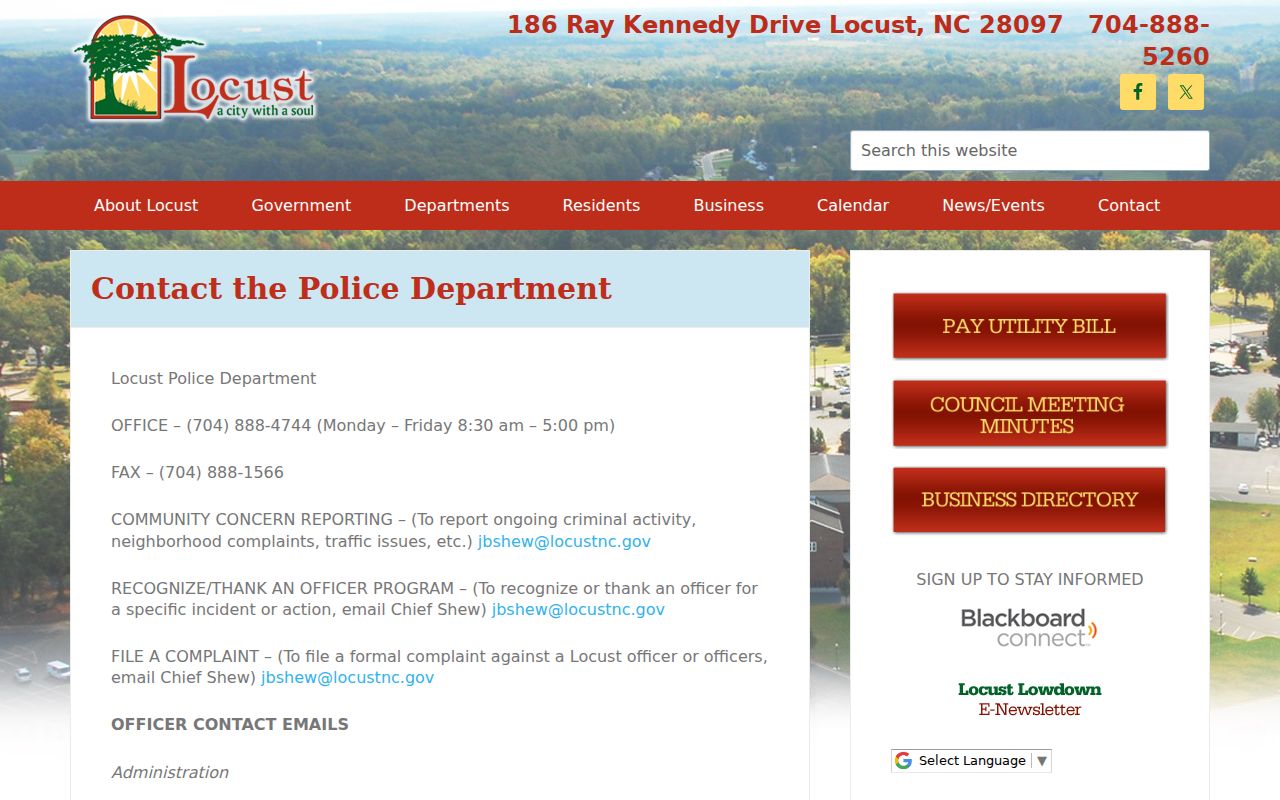
Use the displayed Locust office details to ask what identifying facts, delivery method, and current copying charge apply. If PD cannot locate an administrative Locust record, City Clerk Amanda Furr at afurr@locustnc.gov is the documented fallback. An ongoing Locust neighborhood, traffic, or activity concern is different from a request for an existing report.
Locust Police Department
186 Ray Kennedy Drive
Locust, NC
704-888-4744
Monday-Friday, 8:30-5
Locust Criminal Record Statistics Archive
Locust provides a useful public archive that many small departments do not. The monthly crime statistics page collects department PDFs, and some 2023 months include separate arrest reports. Annual reports are also available from the city. These files help show the volume and types of police activity during a period, but they are not a complete historic name search and do not replace a case file.
The official archive image below shows where Locust publishes those monthly materials. Search the page by month and open the relevant PDF rather than treating the newest file as coverage for all years.
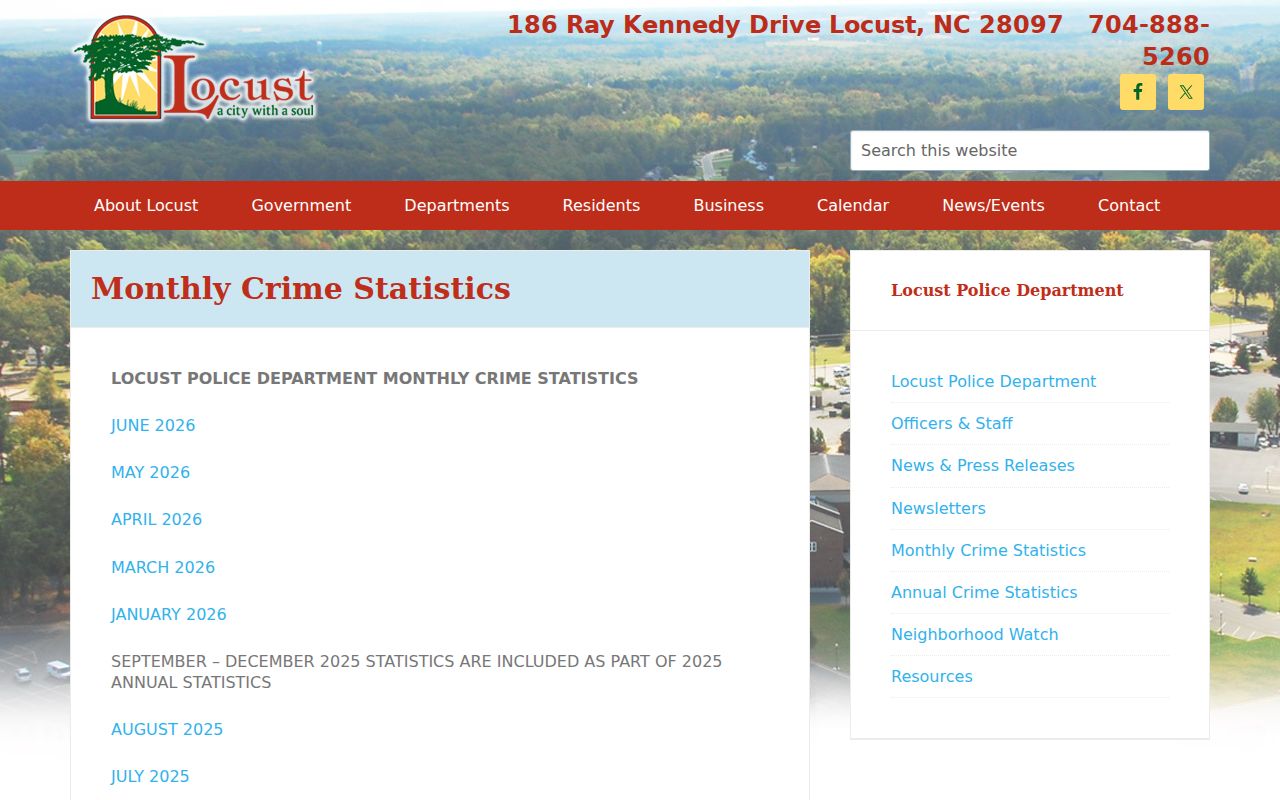
A missing name or month does not prove that no report exists. Some reports may be withheld, redacted, not posted as separate arrest PDFs, or retained only at the department. Contact PD with the incident details when the public archive does not answer the question.
Arrests and Bookings in Locust
A Locust arrest generates related records at different points. City officers create the arrest or incident report. Booking staff create a custody entry if the person enters a county jail. Fingerprints can support an SBI criminal-history event. A magistrate and clerk create the court record. Alleged booking charges can change after a prosecutor reviews the matter.
Locust advertises no city detention center. For a Stanly-side booking, use the Stanly current-inmate roster or call Booking at 704-986-3739. The roster covers current local custody, not every past Locust arrest. Cabarrus-side custody must be checked in the appropriate Cabarrus channel rather than inferred from the city's name.
Note: A Locust arrest PDF or jail roster entry documents an allegation and custody event, not guilt or a final court result.
Why Locust Report Counts Fell
Locust's 2024 report warns readers against a shallow year-to-year comparison. Officers were allowed to omit a full report for minor noncriminal calls when no party asked for one. Body-camera video, dash-camera video, and dispatch notes still had to be kept. A lower report count can therefore reflect a documentation rule, not just less activity.
If a minor call produced no full incident report, ask Locust PD what record does exist. Dispatch notes or recordings follow their own access rules, and police video is governed by North Carolina's special disclosure and release statute. A request should name the date, location, call type, and officer when known. Do not ask the city to create an incident narrative that was never made.
This caveat is vital when using Locust criminal history statistics. Data definitions and collection methods set the meaning of the number. They do not decide what happened in one named event.
Locust Municipal Court Records
Locust has no municipal court. North Carolina operates a unified General Court of Justice, so ordinance, traffic, misdemeanor, and felony matters move through state District or Superior Court. For a Stanly-side case, the Stanly County Courthouse and Clerk of Superior Court are the local record sources. A Cabarrus-side event may require the Cabarrus clerk.
| Court Name | North Carolina District and Superior Courts, not a Locust municipal court |
|---|---|
| Case Types Heard | Infractions, traffic, misdemeanors, felony preliminary matters, felony trials, and eligible appeals |
| Case Lookup Channel | eCourts Portal, Court Dates, courthouse terminal, or clerk file |
| What the Docket Shows | Case number, public parties, events, hearings, disposition, and judgment data when available |
| Copies & Fees | Set by the state court schedule; certified one-county name search is $25 |
Portal offers free public case information, but the Judicial Branch tells people conducting a formal criminal-record search to use the clerk's office. A free courthouse terminal can search county or statewide records. Paper files and certified results come from the clerk in the county of filing.
Locust Criminal Case Clearance Context
The official 2024 Locust report records 1,103 incident reports. It lists 15 open matters, 1,033 closed matters excluding exhausted leads, and 55 leads-exhausted or inactive matters. Of 427 confirmed criminal incidents, 370 were cleared by arrest, stated as 86.7 percent. It also separates 295 property or fraud incidents, with 232 satisfactory clearances, or 78.6 percent.
A clearance by arrest is not the same as a conviction. A citation can satisfy an arrest-clearance rule, and the prosecutor or court may later change or dismiss a charge. The statistics describe Locust police operations. For an individual's outcome, read the filed court disposition and judgment.
Where Locust Records End Up
The newest Locust information often remains closest to its source. PD holds the incident report. The relevant county jail shows current custody. The clerk and Portal show the filed case. SBI Computerized Criminal History may later carry the fingerprint-supported arrest and a reported disposition. Detailed motions and orders stay in the court file.
Record flow: Locust Police Department › correct county court › North Carolina State Bureau of Investigation.
Because Locust crosses a county line, confirm venue at every handoff. If the state history lacks a disposition, check the clerk's judgment. If the Portal has no match, verify spelling, location, wildcard format, and case number before deciding the event is absent.
Locust History Behind City Records
The city's official Locust history traces the community to “Crossroads,” founded by German, Scotch-Irish, and English immigrants in the late 1860s. A well near a locust tree served travelers and livestock. The post-office community became Locust Level in 1869, and “Level” was dropped on May 29, 1894.
The source image below reflects the city's own historical account, not a criminal-record database.
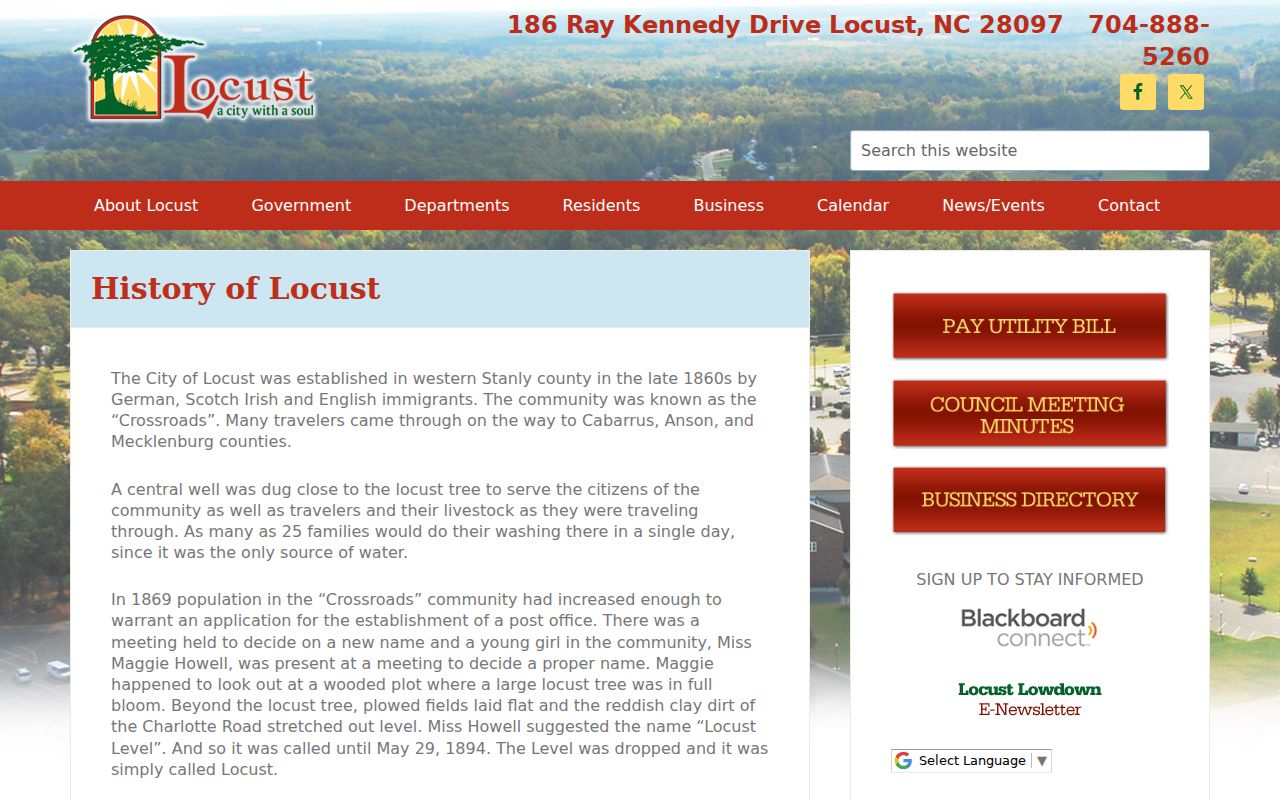
Locust still sits at a crossroads linking Charlotte, Albemarle, Concord, and Monroe. Rapid growth and two-county geography make precise event locations even more important in modern records. The official slogan, “A City With a Soul,” gives local context without changing which agency holds a police or court file.
Locust Criminal Report Status Terms
Locust's reports use operational categories that should be read on their own terms. They describe police handling, not a court verdict. A case may be closed at the agency while a criminal prosecution remains pending or ends without conviction.
- Open
- The police matter remains active under the department's reporting method.
- Leads exhausted or inactive
- Available investigative steps did not yield more action at that time.
- Cleared by arrest
- Police met the reporting definition through an arrest or qualifying citation; it does not prove guilt.
- Satisfactory clearance
- The report's property or fraud tracking category records the department's stated resolution measure.
Use these terms to understand the monthly or annual report. Use the court disposition to learn whether a filed charge ended in dismissal, acquittal, plea, or conviction.
Public Access Rules
North Carolina Public Records Law applies to records kept by Locust, subject to specific confidentiality laws. Criminal investigation material is not wholly open. The law distinguishes public incident and arrest information from investigative detail. Juvenile data, sealed cases, protected identities, and other confidential content can be withheld or redacted. Police recordings use a distinct court-centered disclosure and release process.
Key Statutes:
North Carolina Public Records Law provides the general framework for access to government records.
G.S. 132-1.4 sets criminal investigation and public arrest-information boundaries.
G.S. 132-1.4A governs law-enforcement recording disclosure and release.
A city denial does not make a related court file confidential. It means the requester must distinguish the protected police material from the separate public judicial record. For the full progression after filing, consult the Stanly County criminal court case records when Stanly is the county of venue.
Locust Criminal Record Fallback Chain
When the archive has no useful file, contact Locust PD. When no one is shown in the current roster, ask whether the person was booked elsewhere or already released. When Portal shows no case, verify the county, spelling, search type, and date. The city may have the first report even when another county holds the jail or court record.
For a certified Stanly-only name search, Form AOC-CR-314 and $25 go to the Stanly clerk. A free courthouse terminal can search statewide court information. A person reviewing their own fingerprint-supported statewide North Carolina history uses SBI Right to Review. Each fallback answers a narrower, well-defined question.
Note: No official source identifies a complete Locust arrest database, so the monthly PDFs should never be described as exhaustive.